

September 2026—If you’re out and about during the late summer, you’re likely to come across the invasive Joro spider (Trichonephila cilata). This large, brightly-colored spider is native to East Asia and was introduced into the United States around 2014. Since its arrival, the arachnid continues to expand its range across the Southeast. Learning and Engagement Specialist Tish Gailmard dives into the recent research and finds some interesting information! Read on to find out how the invasive spider may be less of an ecological burden than was previously expected.
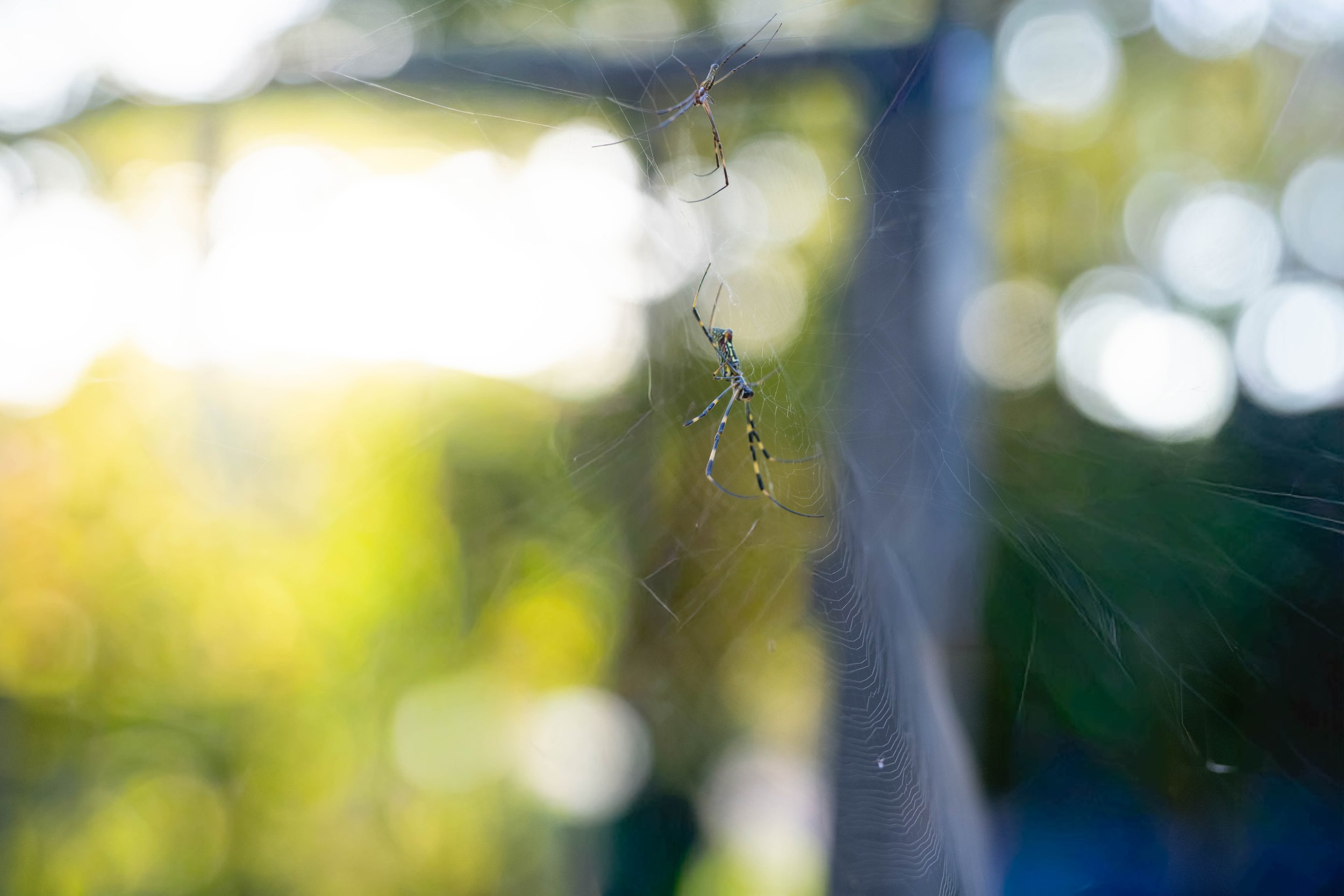
Are Joros outcompeting native spiders? What are they eating? Are they taking space away from native spiders? What should we do with the ones we see? There are some new research results available, but there are still many unknowns. However, research is determining that Joros are eating different prey species than their native orb weaver cousins.
From a UGA Today publication, Professor Jason Schmidt co-author of a study comments, “in terms of direct competition for food, our study suggests Joro spiders eat different insects and a wider variety as compared to native orb weavers.”
UGA Today states, “researchers analyzed the stomach contents of more than 200 Joro spiders from 33 sites across Georgia and South Carolina. They compared DNA fragments found in the digestive tracts of these spiders to more than 140 native orb weavers from across the two states.” This gut analysis comparison found that Joro spiders are eating different prey. There was some overlap of prey items, but the diets of Joros and native orbweavers differed significantly. “In fact, the Joros preyed on 26 unique species that the native spiders didn’t touch, including a variety of bugs such as leafhoppers and aphids.”
The study also determined native spider species had the same diet regardless of whether Joros were present in the area. “This finding suggests that Joros aren’t necessarily making it more difficult for orb weavers to find their favorite snacks,“ Professor Schmidt states.“ In terms of direct competition for food, our study suggests Joro spiders eat different insects and a wider variety as compared to native orb weavers. The composition of native orb-weaving spider diets overlapped more so with one another than with Joro spiders.”
Some have questioned whether the Joro is consuming butterflies, specifically the Monarch. The study found the Joros are not consuming butterflies, Monarch or others.
With their very large, three dimensional webs that often interlace with an additional web, Joros are taking up a lot of physical space. The Joro architecture is quite different from other spiders. UGA research notes, “young spiders spin silk that is clear and looks much like any other web spider silk, but as they grow the silk becomes thicker and stronger. Mature females spin silk that is yellow or golden in color and very strong and sticky.” I’ve witnessed what appears to be multiple webs that are connected like a bunch of spider townhomes. On the webs, you often see several females and many males who just hang out nearby.
Professor Schmidt doesn’t believe the Joros are spatially out competing native spiders. Native spiderwebs have been located next to Joros in some locations. Professor Andy Davis, formerlywith UGA, now with Kennesaw State University, notes Joros tend to make their webs in places that other spiders don’t, including higher locations and more urban locations.
Without records of how many spider species inhabited an area prior to the Joros’ arrival, it’s hard to determine their spatial impact. On your next hike, look above you on the trail and in higher levels of the forest. I often see Joros at these locations.
Professor Davis notes Joros are a new neighbor and we need to recognize they are not damaging any forests like some other invasives. They are consuming pest insects and they are prey for lizards and some birds.
Joros are spreading rapidly along the east coast. Given the Joro’s native Japanese climate, they are expected to be cold hardy, allowing for expansion into more northern climates which have a similar latitude, making it an ideal home. Joros can survive early freezes that kill off other arachnids. Egg sacs are laid mid-October to November and are dense, white silk sacs with 400-500 eggs. Sacs are attached to leaves, tree bark, and human-made structures, not within webs. Given the fast spread of Joros, the egg sacs appear to survive cold temps and hatch April-May.
The Joro has one generation per year with females becoming sexually mature in September and early October while males reach sexual maturity by late August.
Professor Davis clearly states killing the Joro is futile, “the horses have left the barn, no good closing the door now.”
We need more research to learn if the Joro spider will ultimately pose an ecological threat to native species. For now, let’s leave them alone to perform their ecosystem services. If you can’t stand having these eight legged female beauties and their drab male counterparts around, I highly encourage you to remove them with a broom. Do not use a broad spectrum insecticide. No insecticide kills only spiders, so a spray of bug killer will demolish beneficial insects that you definitely want in your yard, like ladybugs, green lacewings, praying mantis,parasitic wasps, and hoverflies. UGA suggests not allowing Joros webs around pollinator/flower gardens and bee hives.
Continue reporting your Joro sightings on iNaturalist. You can also report Joro spider locations by email it to UTKJoroProject@utk.edu. Your reports help UTK researchers map the spread of the species and better understand its spread. Your info should include location (on your phone photo, scroll up and open in maps to spot the longitude and latitude) and a good quality photo.
You can also report your sightings on a UGA supported page called jorowatch.org. There’s even a photo contest this October (2026)!